

FIBRES AND COMPOSITIONS IN PADEL RACKETS
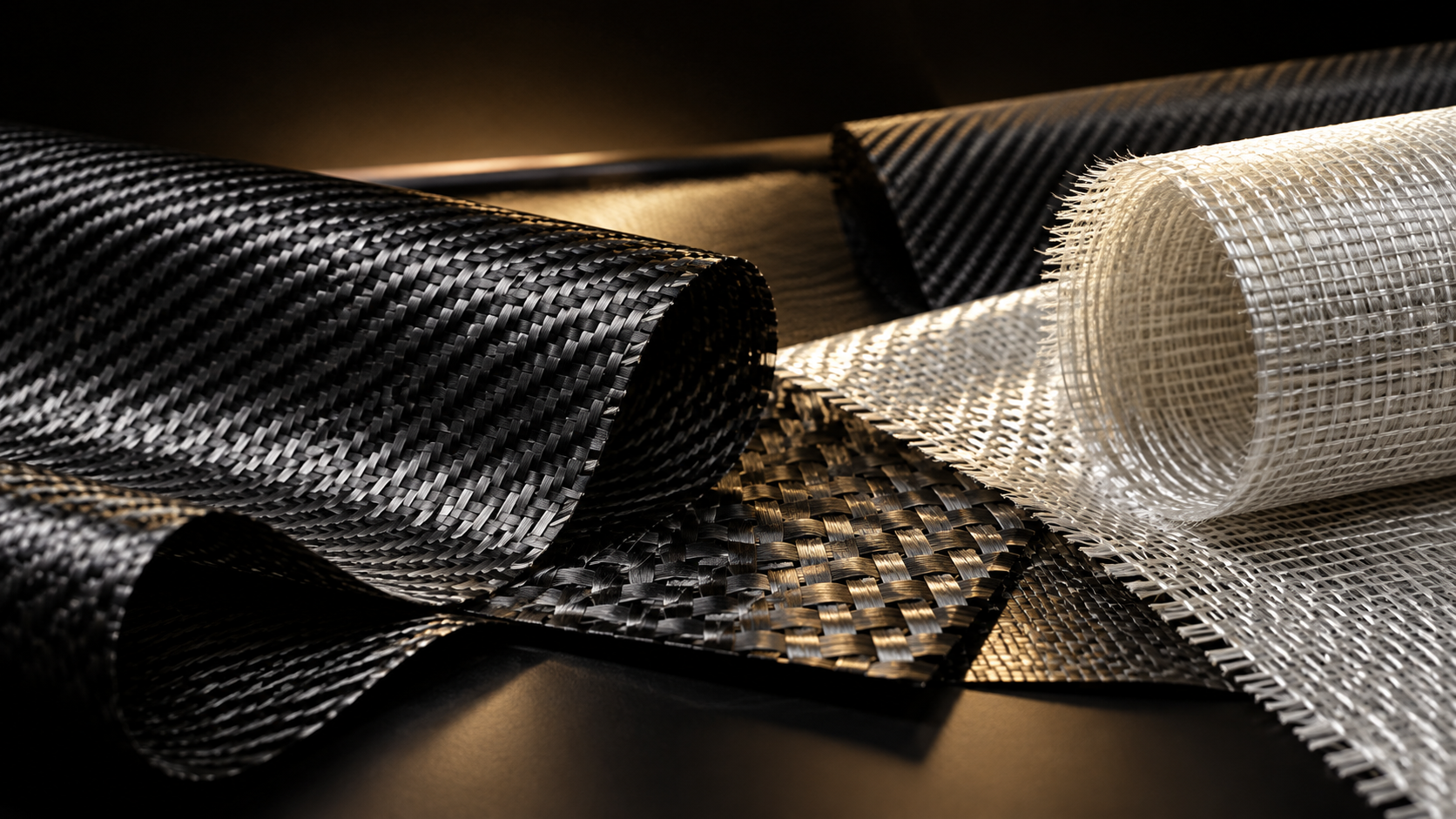
The composition of a padel racket's faces is one of the factors that determine its performance on court.
Carbon fibre, fibreglass and their different combinations make it possible to develop structures with distinct properties in terms of stiffness, flexibility, strength and impact response.
However, no single material guarantees superior performance on its own. Its behaviour depends on the overall construction of the racket, the fibre orientation, the number of layers, the resins and the interaction with the core.
At AUREA PÁDEL MAÎTRES, material selection is guided by the technical characteristics we aim to achieve in each development, rather than commercial designations or market trends.
CARBON FIBRE IN PADEL RACKETS
What do 3K, 12K, 18K and 24K mean?
The K designation indicates the approximate number of filaments making up each carbon fibre tow:
-
3K: 3,000 filaments.
-
12K: 12,000 filaments.
-
18K: 18,000 filaments.
-
24K: 24,000 filaments.
These figures do not directly indicate the quality, stiffness or final strength of a racket.
A 24K fabric is not necessarily superior to a 3K, 12K or 18K fabric. The final behaviour depends on the type of fibre, the fabric architecture, the layers used, the resins and their interaction with the core.
Quality is not measured by filament count alone, but by the coherence of the entire construction.
construction.
FIBREGLASS IN PADEL RACKETS
Fibreglass is one of the most widely used reinforcement materials in padel racket manufacturing. Its ability to combine strength, flexibility and a competitive production cost makes it a versatile alternative to carbon fibre.
In general terms, fibreglass laminates offer lower stiffness than carbon laminates, although their final behaviour depends on the type of fabric, fibre orientation, resins and racket construction.
What does fibreglass contribute?
-
Greater flexibility: allows the development of faces with more pronounced deformation during impact, depending on the laminate configuration.
-
Ball feel: can contribute to a more elastic response and a less rigid contact sensation.
-
Versatility: allows different responses to be combined by adjusting the racket's overall behaviour.
-
Hybrid combinations: can be used together with carbon fibre to achieve a specific balance between stiffness and flexibility.
Is it inferior to carbon fibre?
Not necessarily. Although carbon fibre offers higher specific stiffness, this does not mean it is always the better choice.
Fibreglass can be particularly suitable when a specific level of elasticity and ball feel is required.
The choice between carbon fibre and fibreglass should follow a technical requirement, rather than a commercial hierarchy of materials.
HYBRID COMPOSITIONS: CARBON FIBRE AND FIBREGLASS
Hybrid compositions combine different reinforcement materials within the same structure to achieve specific mechanical properties.
In padel racket manufacturing, combining carbon fibre and fibreglass makes it possible to adjust the stiffness, deformation of the faces and impact response.
How do hybrid compositions work?
Materials can be combined in different configurations:
-
Outer carbon layers with inner fibreglass layers: allow laminates in which carbon provides stiffness while fibreglass modifies the overall response.
-
Outer fibreglass layers with inner carbon layers: offer a different distribution of stiffness and deformation, with behaviour influenced by the thickness of the layers and the materials used.
-
Hybrid fabrics: integrate carbon and fibreglass within the same fabric, allowing specific configurations to be developed.
The importance of construction
Simply combining materials is not enough to produce a balanced racket.
The number of layers, their orientation, their position within the material structure, the resin system and the core determine the final behaviour.
For this reason, two rackets made with carbon fibre and fibreglass can offer very different sensations and performance.
At AUREA PÁDEL MAÎTRES, a hybrid composition is not a commercial category: it is a development tool used to achieve a specific technical response.
FIBRE ORIENTATION AND LAMINATE STRUCTURE
Fibre arrangement and the number of layers are fundamental factors in the mechanical behaviour of a padel racket's faces.
Two rackets made with the same type of carbon fibre can offer different responses if the fibre orientation, lamination sequence or final laminate thickness changes.
How does fibre orientation influence performance?
Composite materials reinforced with fibres have properties that depend on the direction in which the fibres are arranged.
-
0° orientation: promotes stiffness and strength along the main fibre direction.
-
90° orientation: provides reinforcement in the perpendicular direction.
-
±45° orientations: contribute to controlling shear deformation and the laminate's torsional response.
Combining different orientations makes it possible to design structures with more balanced mechanical properties.
Do more layers mean higher quality?
Not necessarily.
Increasing the number of layers can increase the laminate's thickness, mass and stiffness, but it also changes weight distribution and the racket's dynamic response.
The result depends on the fabric weight, material quantity, fibre orientation and number of layers.
A correctly designed construction with fewer layers may respond better to certain objectives than a thicker, heavier laminate.
Padel racket engineering is not about accumulating materials, but about selecting and arranging each component to achieve the desired behaviour.